Welcome to Foundation for Evidence-based Development in India(FEDI)


Welcome to Foundation for Evidence-based Development in India(FEDI)

 EBP Mechanism
Evidence based practice (EBP) emerged in 1990s in health care arena and quickly rose to popularity. Later it found its way to other areas of public importance and has had significant impact on policy and practice in public services, medicine, social services, education, personnel development, management, nursing, dentistry and general healthcare. It is not only able to refine and prioritise the strategic direction but also able to deliver relevant and timely answers to a need for rapidly changing policy.
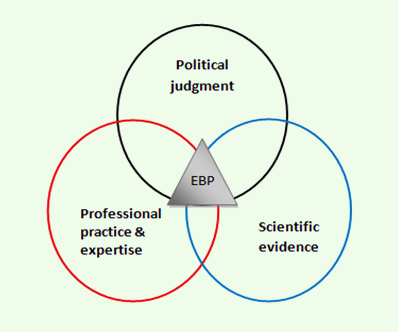
EBP is the conscientious, judicious and explicit use of the current state of the art evidence in making decisions about the care of individuals and development of organisations. It integrates individual practitioner expertise with the best available external evidence in making decisions about how to deal with problems and issues and develop practice and services. Thus evidence base delivers best practices to clients through integrating actual situation, previous research and experience of experts as illustrated in the figure below (Source: Gibbs &Gambrill, 2003).

EBP follows a systematic process which minimises the dependence of the client organisation on an area guru and is inherently based on ethical consideration, effectiveness, and honesty/ transparency. It follows judiciousness because the decision to incorporate a piece of evidence into practice is based on sound considerations and prudence. The use of the current best evidence equips the practice and policy decisions that benefit from the most informative lessons that reduce the repeat of test-and-error practice hence making the achievements cumulatively progressive. Since the use of evidence-based practice is transparent, the providers, implementers, consumers, clients and the public have explicit knowledge of the processes and results, hence facilitating the decision making processes, feedback, satisfaction on service delivered and consumed. This maximises the use of resources, improves performance and promotes professional, organisational and financial accountability driving health and socio-economic development to desirable heights and strategic development.
While identifying the gap areas and mechanisms to address those gaps, evidence based practice features some characteristics listed in the following point-wise descriptions:
Main features of evidence-based practice:
Steps involved in Evidence Synthesis:
Methodological approach in evidence-based practice
As a holistic approach, evidence-based practice adheres to a hierarchy of the best, current, and available evidence while incorporating client and practitioner values. As a constantly evolving system, it provides a mode of comparison for competing interventions and a set of tools to make informed decisions